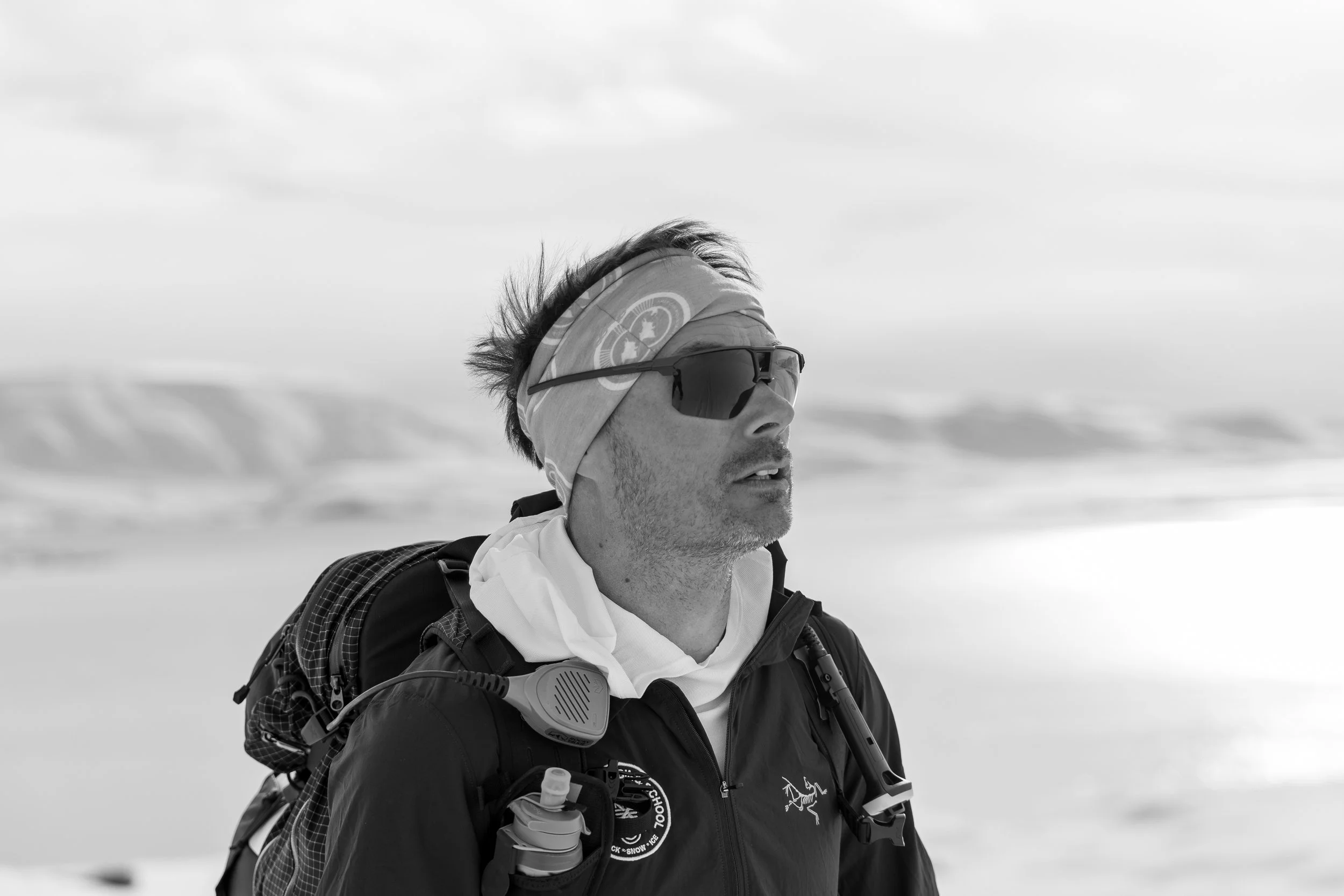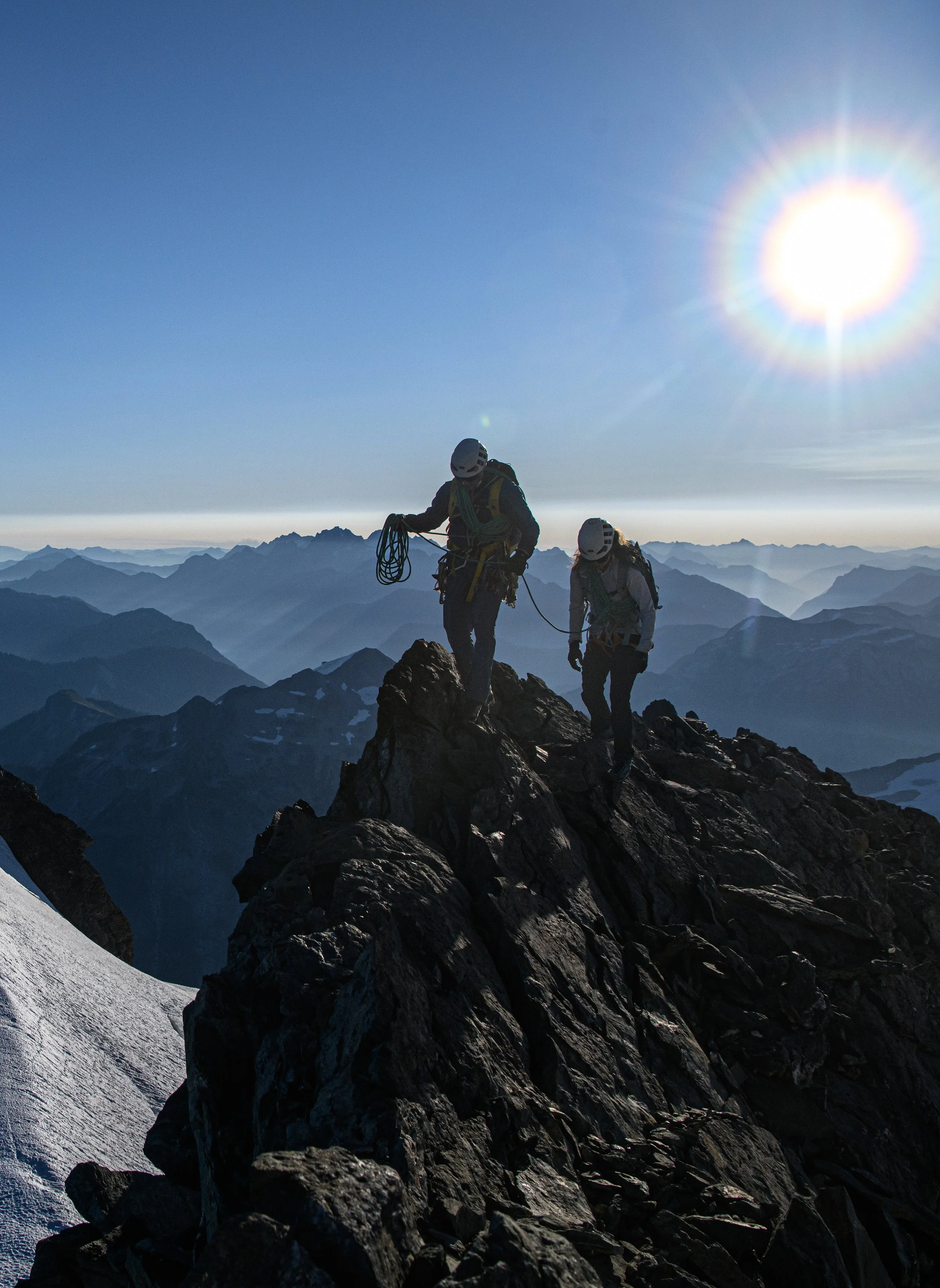
IFMGA Mountain Guide, Karsten Delap short-roping on Mt Shuksan.
I've been asked some version of this question hundreds of times:
"What's the difference between a guide and a certified guide or Mountain Guide?"
It's a fair question. And honestly, the outdoor industry hasn't done a great job of answering it clearly. So let me just tell you straight — because the answer matters more than most people realize when they're choosing who to trust with their safety in the mountains.
The Credential Ladder Most People Don't Know Exists
In the United States, guide certifications are managed by the American Mountain Guides Association (AMGA). The progression looks like this:
Single Pitch Instructor (SPI)— The entry-level standard for climbing instruction in the U.S. Covers top-rope and single-pitch settings. This is the minimum credential a professional climbing instructor should hold. It's a meaningful bar, and I've been training and examining SPI candidates for over 15 years.
Multi-Pitch Instructor (MPI) — Bridges the gap between single-pitch instruction and full guide certification. Covers leading clients on sustained multi-pitch routes, advanced anchor systems, rappelling, and managing teams in more committing terrain. A significant credential that relatively few instructors hold.
Certified Rock Guide — A significant step up. Covers multi-pitch trad climbing, anchor systems, leading in complex terrain, and client management on sustained routes. I completed the Rock Guide program in 2009, becoming the second person in the Southeast to earn this certification.
Certified Alpine Guide — Adds glacier travel, crevasse rescue, and alpine climbing in serious mountain environments. A whole different world from rock.
Certified Ski Guide— The third discipline in the full mountain guide pathway. Covers avalanche terrain management, ski mountaineering, and guiding clients in serious backcountry and alpine ski environments. Combined with the Rock and Alpine tracks, it forms the complete foundation required for the IFMGA certification.
IFMGA Mountain Guide — The top of the pyramid. The International Federation of Mountain Guides Associations credential is the gold standard worldwide. It combines all three disciplines — rock, alpine, and ski mountaineering — at the highest level of competency. In the spring of 2021, I became the **159th American** to complete the IFMGA certification.
In the entire Southeastern United States, I am the only IFMGA Mountain Guide.
What That Actually Takes
I'm not listing credentials to pat myself on the back. I'm listing them because when you're deciding who to hire for a guided climb — especially if you're new to the mountains — you deserve to understand what qualifies someone to do this job.
The IFMGA process is long. It took me years of coursework, assessments, and field evaluations. It covers everything from leading rock routes to ski mountaineering in serious alpine terrain to glacier rescue. Every component is rigorously examined by international assessors. There's no shortcut and no participation award.
To get a sense of the field: there are nearly 7,000 IFMGA guides worldwide — but the vast majority are concentrated in Europe, where the certification originated. In the United States, fewer than 200 guides have completed the full IFMGA certification. I am number 159.
It's a rare certification. It should be.
Why This Matters When You're Choosing a Guide in Western NC
Here's where I want to be direct with you.
There are good guide services in Western North Carolina. I'm not here to disparage anyone. But there are also services operating with guides who have minimal or no formal certification — and in some cases, no certification at all. In most states, including North Carolina, there is no legal requirement for a climbing guide to hold any specific credential. The market polices itself, which means the burden is on you as a client to ask the right questions.
When you hire a guide, you are trusting that person with your life in an environment where mistakes can be catastrophic. The right questions to ask any guide service:
- What certifications do your guides hold? SPI? MPI? These are the benchmarks that matter.
- Who is the senior guide overseeing your instruction program? What are their credentials — and are they actually in the field with clients, or just a name on the website?
- How experienced is the full team, not just the lead guide? A strong operation has depth. Every guide should be certified and actively working at a high level.
- How long have your guides been working in the Southeast specifically? Local knowledge of rock type, weather patterns, and specific routes matters enormously and can't be faked.
At Pisgah Climbing School, our guides hold AMGA certifications at multiple levels. Our instruction programs are overseen by the only IFMGA Mountain Guide in the region, with 20 years of professional guiding experience behind every program we run. We are the largest guide service in the Southeastern U.S., and we built that entirely on the quality of what we do.
What Clients Actually Experience Because of This
The difference between a good guide and a great one isn't visible until something goes sideways. That's when training, experience, and deep technical knowledge show up — or don't.
It's in how quickly a guide reads changing weather and adjusts the plan. It's in how a route is selected not just for difficulty but for the client's specific physical and mental state that day. It's in how a team moves through complex terrain efficiently, how anchors are built with both speed and redundancy, how risk is managed dynamically rather than by just a checklist.
I've guided in the Black Canyon of the Gunnison, on Long's Peak, in the Tetons, in Patagonia, in the Indian Himalaya. I've done search and rescue on Looking Glass Rock and responded to incidents all over the Southeast. I currently serve as the Technical Director of the Mountain Rescue Team for the Transylvania County Rescue Squad and remain an active member of the Henderson County Rescue Squad. Several of our guides serve alongside me on these teams. That's not a marketing point. That's what it looks like when people take vertical terrain seriously enough to show up when it matters most.
I hold a SPRAT Level 3 certification — the highest level offered by the Society of Professional Rope Access Technicians — and several of our guides hold SPRAT certifications as well. Rope access is a completely different world from recreational climbing: it demands precision rigging in industrial and confined-space environments where there is zero margin for error. That discipline sharpens technical rope skills in ways that translate directly to how we build anchors, manage systems, and keep clients safe on the rock.
I've seen what happens when guides are underprepared, and I've seen what happens when they're not.
That experience is the foundation of every program at Pisgah Climbing School — from a first-timer's introduction to outdoor climbing all the way to our military training programs and multi-pitch expeditions.
The Southeast Has World-Class Climbing. It Deserves World-Class Guiding.
Western North Carolina and the Pisgah National Forest are genuinely remarkable. The granite domes of Looking Glass Rock, the intricate face climbing at Cedar Rock, the sustained routes of Linville Gorge — this is some of the finest rock climbing on the East Coast, and it deserves to be experienced with a team that can do it justice.
That's what we've built at Pisgah Climbing School. A team of passionate, certified, deeply experienced guides working out of Brevard, NC — doing things differently, on purpose, every single day.
If you're ready to get on the rock, we’d love to take you there.
Explore programs and book at pisgahclimbingschool.com → (https://pisgahclimbingschool.com)
Here is a client review on YouTube from a guest of ours:
Karsten Delap is the 159th American to earn the IFMGA Mountain Guide certification and the only IFMGA Guide in the Southeastern United States. He is the founder of Pisgah Climbing School — the largest guide service in the Southeast — and has been guiding and instructing for over 20 years across North America, South America, Africa, and the Himalayas. He is a licensed AMGA SPI Provider Trainer, a Petzl athlete ambassador, and a Wilderness Emergency Medical Technician.